Don’t Ban AI; Make It the Co-Pilot for Every Student’s Genius Hour

Let’s start with the “Why.”

Why do we believe in Genius Hour? Why do we champion Project-Based Learning?

It’s not just to keep kids busy. It’s a rebellion against the industrial model of education. We believe that every student who walks into our classroom has a spark—a unique curiosity, a nascent passion, a question only they can ask.

The promise of Genius Hour is the promise of purpose. It’s an opportunity for students to work on something that matters to them, for an audience beyond their teacher. It’s the beautiful, messy, exhilarating work of turning wonder into something real.

But let’s be honest about the friction.

Every teacher who has run Genius Hour knows the hurdles. The student who stares at a blank page and sighs, “I don’t have any ideas.” The project that starts with a bang but fizzles into a shallow copy-paste from Wikipedia. The immense challenge of trying to mentor 30 unique, complex projects at once.

We believe in the “Why,” but the “How” can burn us out.

Now, a new tool has arrived. And most schools are asking the wrong question. They’re asking, “How do we stop students from cheating with AI?”

That’s a question born of fear. It’s a question about protecting the old system.

A better question—a remarkable question—is this: What if we gave every single student an AI co-pilot to supercharge their genius?

Instead of a threat, what if we saw AI as the single greatest tool ever invented to scale curiosity, deepen inquiry, and help students create remarkable work?

Here’s how it works. Think of AI not as an answer machine, but as a series of creative partners.

1. The Idea Catalyst: Killing the Blank Page

The hardest part is starting. AI is the ultimate brainstorming partner. It never gets tired and has no bad ideas.

  • The Problem: A student says, “I like video games, but I don’t know what to do for a project.”
  • The AI Co-Pilot Prompt (The Hook): “Act as a creative strategist. I’m a student who loves video games and history. Give me 10 project ideas that are not a simple report. They should combine game design, storytelling, and a historical event. One idea must involve building something.”
  • The Result: The blank page is gone. Now the student isn’t staring at a void; they’re making a choice. They’re in the driver’s seat.

2. The Research Sherpa: Escaping the Wikipedia Rut

Good projects are built on good questions. AI can help students learn to ask better questions and navigate the overwhelming sea of information.

  • The Problem: A student’s research is shallow, pulling only from the first page of Google.
  • The AI Co-Pilot Prompt (The Hook): “I’m researching the fall of the Roman Empire for my project. Act as a university professor. What are three common misconceptions people have about this topic? What are the names of two primary sources I should look for? Suggest one contrarian historian I should read.”
  • The Result: The student is no longer just finding information; they are interrogating it. They are learning to think critically and explore diverse perspectives, guided by their personal research assistant.

3. The Prototype Partner: From Idea to First Draft

Every creator knows the power of a prototype. It’s about making the idea tangible. AI can help students build that first version, turning a concept into something they can see and improve.

  • The Problem: A student has a great idea for an educational podcast or a short film but has no idea how to structure it.
  • The AI Co-Pilot Prompt (The Hook): “I want to create a 5-minute podcast episode for 5th graders about how black holes work. Generate a script outline with a catchy intro, a simple analogy to explain the concept, a fun fact, and a call to action for listeners to learn more.”
  • The Result: The student isn’t getting a finished product. They’re getting a scaffold. A starting point they can now argue with, rewrite, and make their own. It removes the intimidation of creation and invites them to start building.

This Changes the Teacher’s Job (For the Better)

When students have an AI co-pilot, the teacher is freed from being the source of all knowledge. Your job is no longer to have all the answers.

Your job is to become the Architect of Experience.

You are now the head coach, the lead questioner, the creative director. You can spend your time on the things that only a human can do:

  • Asking a student why this project matters to them.
  • Helping them navigate the frustration when their prototype fails.
  • Connecting them with a real-world audience for their work.
  • Fostering the resilience, empathy, and collaborative skills that AI can’t teach.

This is our opportunity to make a ruckus.

Let other schools install blockers and run plagiarism checkers. You can be the one to run the experiment. Start small. Pick one class. Pick five students. Give them permission to use their AI co-pilot and see what they create.

The future of learning isn’t about memorizing what a machine can already tell us. It’s about using these incredible new tools to do what humans do best: to dream, to inquire, to build, and to connect.

Let’s not just prepare our students for the future; let’s equip them with the tools to shape it.

This post was written with the help of Google Gemini 2.5 Pro.
Level Up Your Learning: How Gemini is Revolutionizing Education

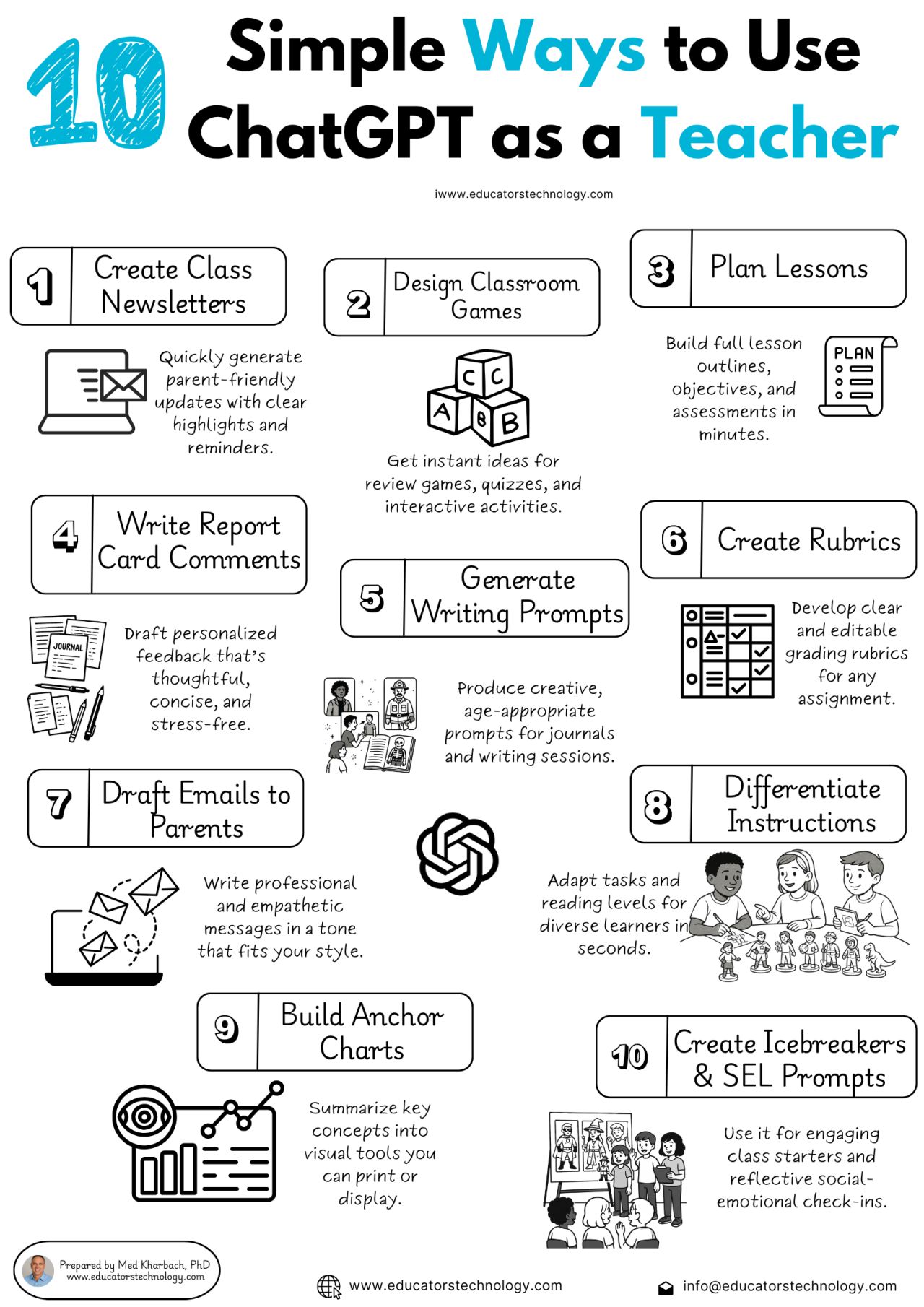
The education landscape constantly evolves, and a new powerful tool is stepping into the classroom: Gemini, Google’s cutting-edge generative AI. This isn’t just another tech trend; Gemini offers many ways to enhance teaching and learning, benefiting educators and students. From streamlining administrative tasks to fostering personalized learning journeys, its potential is vast.

So, how exactly can Gemini be integrated into the educational sphere? Let’s explore at least five compelling examples:

1. Personalized Learning Companion and Tutor:

Imagine a student struggling with a complex math problem or a historical concept. Gemini can act as a 24/7 personal tutor, providing step-by-step explanations, breaking down difficult ideas into simpler terms, and even generating practice quizzes tailored to their specific needs. For students who are shy about asking questions in class, Gemini offers a safe space to explore topics at their own pace and receive immediate feedback. Advanced learners, too, can benefit by using Gemini to delve deeper into subjects and explore more challenging enrichment activities.

2. Supercharging Lesson Planning and Content Creation for Educators:

Teachers, rejoice! Gemini can be a significant time-saver and a source of fresh inspiration. It can assist in:

* Generating detailed lesson plans: Based on specific learning objectives, grade levels, and state standards.

* Creating supplemental materials: Think worksheets, engaging presentations (even suggesting scenes and scripts for videos!), discussion prompts, and varied assessment tools like quizzes.

* Differentiating instruction: Gemini can help adapt reading passages to various Lexile levels or generate diverse project ideas to cater to different learning styles and needs, including those of students with special education requirements or English language learners.

3. Empowering Student Research and Writing:

For students, Gemini can be a powerful research assistant. It can help:

* Summarize lengthy texts and research papers: Making it easier to grasp key information.

* Brainstorm ideas for projects and essays: Helping to overcome writer’s block.

* Provide writing support: By assisting with drafting, offering suggestions for improving clarity and style, and even helping to proofread.

* Gather information: Students can ask complex questions and receive comprehensive answers, and Gemini can often synthesize information from various sources.

4. Streamlining Administrative Tasks for Educators:

Beyond curriculum development, Gemini can help educators manage their workload more efficiently. It can:

* Summarize long email threads and draft replies.

* Assist in scheduling assignments and meetings.

* Help analyze data, for instance, from student performance or feedback.

* Draft grant proposals or letters of recommendation.

5. Fostering Creativity and Engagement in the Classroom:

Gemini’s capabilities extend to fostering a more dynamic and engaging learning environment. It can:

* Generate creative content: Such as stories, poems, or even scripts for class plays, sparking students’ imagination.

* Create interactive learning experiences: For example, by helping to design educational games or interactive quizzes.

* Assist in generating visuals: Creating images or suggesting ideas for visual aids to accompany lessons.

* Translate text: Breaking down language barriers and making learning materials accessible to a broader range of students.

The Broader Impact:

The integration of Gemini into education promises numerous benefits. It can lead to more personalized learning paths, increased student engagement, and valuable time savings for educators, allowing them to focus more on direct student interaction. Furthermore, familiarizing students with AI tools like Gemini helps prepare them for an increasingly AI-driven future workforce, equipping them with essential skills in critical evaluation, responsible technology use, and understanding AI’s capabilities and limitations.

A Note on Responsible Use:

While the potential of Gemini in education is exciting, it’s crucial to emphasize responsible AI use. Educators and students should be mindful of academic integrity, ensuring that AI is used to support learning and original thought, not to replace it. Fact-checking AI-generated content and understanding its limitations are also vital components of digital literacy in the age of AI.

Gemini is poised to be a transformative educational force, offering innovative ways to teach, learn, and collaborate. As this technology continues to evolve, its applications in the classroom will only expand, paving the way for a more dynamic, personalized, and efficient educational experience for all.

On Snowstorms and Shoveling – The Lost Art of Purposeful Parenting

Last night and early this morning, we had our first big snowfall of the year here in New York. When I awoke, over six inches of the powdery white stuff were blanketing everything.  After it finally stopped snowing, my wife and I got the kids suited up in their snow gear and began the dreaded task of snow removal. Everyone in my family, young and old, worked together to clear what Mother Nature had so generously dropped from the sky overnight. If my kids want to play in the snow, they must help to clear the snow.

10309563_981820591832607_2864718001587474161_n

This practice has been passed down to me by my parents, who, from an early age, instilled in my sister and me a work ethic that sadly seems to have been forgotten by many parents in America today. Helping our parents around the house was mandatory in my day. There was no other option. If you wanted to play, you had to pay. This parenting principle has remained in effect in our home as my wife and I raise our elementary school-aged children.

1537907_690204737698590_1003670496_o

Unfortunately, many parents today don’t seem to believe in the importance of this credo. My children were the only kids with shovels in their hands on my block this morning. I saw many dads and a few moms out there snowplowing and shoveling, but the sidewalks were sadly devoid of kids. I assume most were indoors on various electronic devices, texting, listening to music, watching TV, or playing video games as their parents dealt with the snow. And I don’t blame the children for that – I hold their parents accountable for this lazy attitude of entitlement. Why are so many of my friends and neighbors raising kids who feel no obligation to do their part in the work around the house?

Is it because parents are too lazy to fight the battles that my parents fought as they poked and prodded my sister and I out of the house to shovel snow those cold winter mornings of the 1970s? Is it just easier to do it themselves (or to pay someone to do it for them)?

Or have parents forgotten how important it is to instill a sense of obligation to work within our children? A notion that everyone in the family must contribute in some way…to do their fair share….no matter how small their contribution is! A friend of mine used to say that it was easier to do it herself than to wake her son, Johnny, to help her with the shoveling. She explained that he had been up late watching TV the night before. Poor Johnny! This attitude enrages me! My friend doesn’t realize what a disservice she is doing to her child…to her family…to our country!!

1939657_10151972679076345_1738410486_o

Raising children that are active participants in the daily chores of a family is one of the most important contributions we can make to our society. It is imperative that we do this continually! When I take my kids to the supermarket with me, each child has a role. One of my twins is an awesome grocery bagger and she now completes this task without having to be asked. My son is a great scout – running ahead to start our cold cut order at the deli kiosk. And when we pull up to the house each kid is responsible for carrying at least two bags into the house – no ifs, ands or buts about it! My neighbor down the block told me she does all of her food shopping alone because her kids are so poorly behaved. She would rather they stay at home with dad so she can get this chore done quicker and without stress. Doesn’t she realize that she created this problem? If my sister and I misbehaved in the supermarket there was hell to pay! We were scared of our mom’s wrath. Food shopping with my mom was part of the learning process. The refrigerator didn’t get filled magically.

I used to roll my eyes when my grandparents mentioned “the good old days”. I now know exactly what they were talking about, and it makes me sad to realize that many parents today seem to have lost their way.

Thankfully, there is still time to get back to the basics 🙂